
Episode 9 · Tuesday, 5 May 2026

Compounding

Discover how podcast back catalogs gain compounding value over time, challenging traditional metrics and revealing the power of long-term content strategies.

By How To Get Discovered | 17m listen | 9 chapters
Compounding cover
How To Get Discovered · No. 9

About this episode

The "How to Get Discovered" podcast hosts revealed initial disappointment with their three-week discoverability experiment, despite Google indexing transcripts. Data showed only tiny, single-digit results, challenging expectations for immediate impact. This early feedback underscores the long-term nature of compounding effects in podcasting, where back catalogs gain value over years rather than weeks.

Podcast discoverability relies on the compounding effect, where older episodes can accrue more monthly listens years after release than during their initial launch, contrasting with front-loaded listenership models. Cohort analysis helps evaluate this by tracking episode groups, revealing that discoverability-focused shows maintain listenership at a declining but non-zero rate. Newsjacking episodes, while generating short-term spikes, do not compound like evergreen content. Clip-driven listens, shared personally, offer another compounding curve, independent of search trends. Longer clips, such as 5-15 minutes, are crucial for deep listener acquisition, allowing full evaluation before subscription.

One host reflected on 350 episodes over 10 years, acknowledging significant dormant value due to past inaction on discoverability, now accepting new tools can leverage this content. The upcoming season finale will explore the consequences of investing in discoverability versus inaction, featuring a year in the life of two hypothetical shows and revisiting key disagreements from the season.


CHAPTER 01 / 9 Discussion

Podcast Discoverability Experiment: Initial Disappointment

The hosts of "How to Get Discovered" discuss the initial three weeks of a podcast discoverability experiment. Despite transcripts being indexed and Google beginning to crawl pages, the data shows only tiny, single-digit results, leading to slight disappointment for one host who expected a more dramatic, immediate impact. Access to Google Search Console, a higher-tier feature, is currently unavailable.

podcast discoverability· experiment· search console· data· disappointment· indexing

00:00 Welcome back to How to Get Discovered. I'm Maya And I'm Tom HTGD is the show where we argue about how podcasts get found Last week, Tom finally admitted he'd set up his own feed which i'm still slightly basking in She's basking too long... I'm basking the right amount Today's episode is the data one. It's called Compounding, it's about what happens to a back catalog over years, why the curve looks different from what most podcasters expect and why some episodes earn forever and others die in a week And it's the episode I have personal stakes because I am now three weeks into the experiment

00:41 We're going to talk about that, briefly. And then I'm going to talk about my own longer horizon data because three weeks is not a dataset. Three weeks is NOT a dataset! Let's get into it… Okay quick check in... 3 weeks of data What have you got? Nothing Nothing? Nothing useful The transcripts are up The pages are being indexed Google is starting to crawl them The Search Console, I have not connected one because i'm on the starter tier and that's the higher tier feature which I am aware you set up deliberately to make me eventually pay you more money. I didn't set it up – I'm just a customer You're a customer who tells everyone about it! I am Anyway… The pages exist Some episodes are showing up in results for very specific queries The numbers are small Tiny Single digits

01:39 I am, and i'm being honest now slightly disappointed. Why? Because I think...and this is something I should have known going in..I think I had a small part of my brain that thought there was gonna be a thing A switch. A moment where the data showed something dramatic And there isn't! There's just Slow. Right And I knew intellectually that this stuff is slow You've said so for seven episodes, I knew But knowing and experiencing are different And right now i am experiencing slow

CHAPTER 02 / 9 Discussion

Compounding Effect: Back Catalog Value in Podcasting

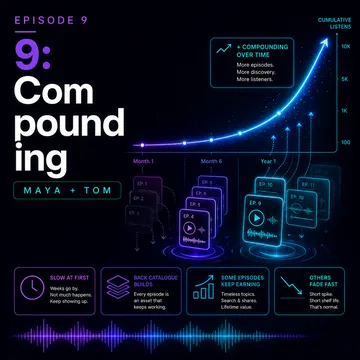
The compounding effect in podcasting describes how a back catalog accumulates listens over years, contrasting with the conventional front-loaded model where most listens occur in the first two weeks. Episodes from early years can receive more monthly listens in later years than during their initial release. This challenges industry measurements focused solely on 30 or 90-day performance, suggesting a different, more enduring asset value for shows with strong discoverability.

compounding· back catalog· podcast listens· discoverability· industry metrics· long-tail listens

02:21 That is exactly what compounding feels like at week three. Which is why I want to do this episode, because compounding is a thing nobody describes accurately— everyone uses the word! Almost nobody is honest about what it looks like. Let me tell you what I expected when I started and what actually happened because the gap between the two is the whole episode. Go When I first put my show through proper transcription and indexing, I'm not going to give you specific numbers because nobody else's specifics are useful and I don't want to make up a story. But the shape of the experience was this...

02:58 First month, almost nothing visible. Pages going up, bits of crawling, tiny trickle... I went to bed every night thinking I'd wasted my time. Familiar Second month, slightly more some episodes starting to appear for queries The kind of queries that looking back are obvious but at the time i didn't know they were the queries The increase was visible if I squinted. It was not enough to brag about, it was not enough to know whether it was working. Right Third month the curve started to do its thing Episodes that had been getting 10 or 20 impressions a month from search were now getting more The volume was real! The shape was... and this is the bit I want to land…the shape was backloaded Not front-loaded

03:50 A typical podcast episode in the conventional model is front-loaded. It comes out, the existing audience listens—the listens decay over days and weeks—the episode is for download purposes basically done after a month The total listens for the episode over its lifetime are mostly the listens in the first two weeks. Right! The search-driven listen pattern is the opposite, the first month is almost nothing... ...the second month is some… each month after that is—for episodes that find their audience—a little more The total listens accumulate slowly, but they accumulate. And they keep accumulating! They keep accumulating for years. There are episodes I made and—I'll be careful with the numbers here— there are episodes from year one of my show that in year three were getting more listens per month than they did in their original release month

04:48 That's the line. That's the line! That's the bit that, when I worked it out made me re-evaluate everything I'd ever recorded Because it's not that one episode is an outlier It's that the entire back catalog has a different lifetime curve than you thought Yes, and the implication—which I want to spell out—is that the way the industry measures podcasts is wrong. Or at least incomplete. Because the industry measures the first 30 days… The first 90 days... The launch…. The spike.... And then it stops counting! Which means a show with a strong back catalog and a show with no back catalog look identical in the industry's measurements even though they're completely different assets

CHAPTER 03 / 9 Discussion

Cohort Analysis: Measuring Long-Term Episode Performance

Cohort analysis is introduced as a technical method to evaluate podcast performance by grouping episodes released at the same time. For shows not focused on discoverability, older cohorts generate minimal listens. However, for shows invested in discoverability, each cohort continues to earn at a declining but non-zero rate, making the total back catalog value significant and changing the calculation of an episode's worth beyond its initial launch.

cohort analysis· episode performance· discoverability· back catalog· ad impressions· long-term value

05:35 That's a real claim. It's a real claim, and I think it is increasingly testable as more shows get their data through proper analytics. The shows that have a back catalog doing actual work? They have a metric on the dashboard the industry doesn't usually measure—long-tail listens, search driven listens, listens that arrive in month 17, month 30, month 40 Now, I want to do something a little more technical. Because I think this is where the episode actually pays off for somebody listening. Imagine you do something called cohort analysis on your show. Cohort analysis is — if I haven't lost you already — a way of looking at performance not by what's happening today but by what's happening to episodes that came out at the same time So instead of how is the show doing this month?

06:26 Instead of, how is the show doing this month? You ask How are the episodes I released in March of year one doing today—all of them as a group. And you can compare that to how are the episodes I released in March of year two doing today and year three and so on. I see And here's the thing. For a show that's not invested in discoverability, for The Standard Show, the answer to how are the episodes from year one doing today is basically nothing. They had their launch, they decayed, they're done. Same for year two. Same for year three. The only episodes generating meaningful listens are the recent ones

07:08 That's the standard pattern. That's the standard pattern! Now, for a show that's invested in discoverability…the answer is different. The Year 1 cohort is still doing something—not as much as recent episodes but not zero. Each cohort keeps earning at a declining but non-zero rate and when you add up all those non-zero rates across years of back catalog... ...the total is significant This is the bit I find genuinely interesting, because it changes how you think about the value of any given episode. How so? The standard mental model of a podcast episode is You spend X hours making it, you get Y listens in the launch window and the calculation is whether X is worth Y And by that calculation, a lot of episodes don't pay off The launch is small, the hours are real...the maths is bad

08:03 Right. But if the episode keeps earning for three years, keeps adding listens, keeps adding ad impressions for any sponsor who's still in the audio then the calculation is different Suddenly the launch isn't the whole return it's the first installment Yes exactly! The launch is the down payment The compounding is the rest of the return And this is the bit that I think is actually genuinely persuasive on its own merits. Because everything else we've talked about has been about acquisition, new listeners, search visits… This is different. This is about whether the work itself has a different value than you thought Right and it does for the episodes that find their audience Some don't some never get picked up but the ones that do

CHAPTER 04 / 9 Discussion

Acknowledging Dormant Podcast Value and Past Inaction

One host reflects on over 350 episodes created in 10 years, acknowledging a potentially large amount of dormant value due to a lack of discoverability focus. This realization caused initial anger towards oneself and hosting platforms, eventually leading to the acceptance that new tools now exist to leverage this untapped content. The key takeaway is to move past anger and begin utilizing available resources.

dormant value· podcast catalog· self-reflection· anger· hosting platform· past inaction

08:54 They have a different lifetime than the conventional model suggests. I want to say something slightly uncomfortable here Go! I have made over 10 years, somewhere north of 350 episodes...I have not done the maths on what that means in this framing because I think the maths would be frankly a little painful You think there's a lot of dormant value? I think there is a lot of dormant value. And, I think that I haven't wanted to look at it directly because looking at it directly would mean admitting that the work I did wasn't getting the return it could have got and nobody likes admitting that about their own work." I had this same realization when I worked through my own catalog. How did you process it? Honestly… It took me a few weeks. I went through a phase of being angry at myself

09:46 Then a phase of being angry at the hosting platform. Then, a phase of just accepting that the tools didn't really exist before and that I could do something with what was sitting there now That last phase is the only useful one That last phase is the only useful one. Anger about past inaction is a tax on your present attention—better to just start! Okay, now I want to do the counterpoint because I've been talking about evergreen episodes—episodes that earn for years as if every episode could be that and it can't some episodes are tied to the moment they came out and they should be Newsjacking

CHAPTER 05 / 9 Discussion

Newsjacking Episodes: Short-Term Spikes vs. Compounding

Newsjacking episodes, created in response to current events, provide immediate spikes in listenership and engage existing audiences but typically do not compound. Their relevance is temporary, meaning their back catalog quickly becomes an archive rather than a continually earning asset. While valuable for timely engagement, a content strategy solely reliant on newsjacking prevents the long-term accumulation of listens seen with evergreen content.

newsjacking· evergreen content· podcast strategy· back catalog· news cycle· content lifetime

10:30 The thing podcasters do when they make an episode quickly in response to something in the news. The hot take, the reaction episode...the this week somebody said this and I have thoughts. I have done many of these We all have done many of these And they are sometimes the right call They get a spike They serve the engaged audience who wants the show's voice on the moment They feel relevant They're good for the show In the moment But... But they don't compound. Almost never, because the question they're answering—the search query they would correspond to—is a temporary question. Nobody is searching six months later for that specific take you had on that specific news event of that week. Right And there is a version —and I have been this podcaster!—of building a whole feed where almost every episode is news-jacked

11:27 where the entire content strategy is responding to the moment. And those shows can do well in their moment, they can have a real audience but their back catalog is dead the second the episode ages out of the news cycle year one and year three is zero your two and you're four is zero The work is consumed and disposed off every single week This is a genuine tension because some of my best episodes were responses to specific moments. Of course! And I'm not saying don't make those episodes, I'm saying be aware of what they are—be aware of the lifetime curve they have and if your entire feed is that shape then you don't have a back catalog—you have an archive. And the difference matters

CHAPTER 06 / 9 Discussion

Clip-Driven Listens: Platform-Independent Distribution

Clip-driven listens offer a different compounding curve than search-driven listens, as they are triggered by personal sharing rather than queries. A clip can circulate in group chats years after an episode's release, bringing in new listeners because the content remains funny, true, or surprising, independent of current search trends. This method is more resilient and less dependent on platform algorithms or indexing layers.

clip-driven listens· platform independence· search queries· algorithm· group chat· listener sharing

12:18 This is where I want to bring up something you talked about a few episodes ago. The clip thing Go Because if i think about it now, the clip thing has a slightly different compounding curve from search Walk me through what you're thinking A search-driven listen is somebody types a question finds a moment listens The driver is the query The query has to exist The query has to be one that's still being asked Right But a clip-driven listen is different. A clip driven listen happens when somebody shares a moment with a friend, the friend watches the clip, the friend might come to the show... The trigger isn't a query — the trigger is…a person! Yes Which means clips can move on a completely different timescale from search. A clip from an episode in year one could go around group chat in year four and bring in listeners

13:13 Not because the question is still being asked, but because the moment is still funny or true or surprising. That's a really nice observation! Thank you And it points at something I've been thinking about which is that the listener-driven clip is the bit of the system that isn't tied to any one platform or algorithm. The search driven listen lives or dies by Google, by whatever the AI assistants do, by the indexing layer—which is increasingly volatile— but a person sharing a clip with a friend in a private message? That's not algorithmically mediated. That's just one person sending another person a thing. Which is more resilient

CHAPTER 07 / 9 Discussion

Longform Clips: Deep Acquisition and Listener Evaluation

The length of shared clips significantly impacts listener acquisition. While 30-second clips serve as top-of-funnel awareness, longer clips (e.g., 5-15 minutes) allow friends to share entire arguments or conversations, providing a more complete experience. Podherd's higher tier, offering up to 15-minute clips, is highlighted as crucial for deep acquisition work, enabling potential listeners to fully evaluate a show before subscribing.

longform clips· listener acquisition· soundbites· podcast segments· Podherd· content evaluation

13:57 more resilient, longer time horizon less dependent on what happens at any given platform. The clip is, if you think about it, the most platform-independent form of distribution a podcaster has. And the longform clip—the multi-minute version—matters here doesn't it? It does because the bit somebody shares in group chat when they're sharing the actual argument not just a soundbite is usually a couple minutes sometimes longer The 30-second clips that get autocut for TikTok? Those serve a different purpose. They're top of funnel, they're awareness, they're algorithm fodder… But the clip a friend sends to a friend is the full bit—the full argument—the full exchange! Which means the length matters. If the clip you can make is capped at 60 seconds, the friend has to make do with a soundbite.

14:54 If it can be 5 minutes, 10 minutes, 15... they can send the whole thing. And the friend on the other end gets the actual experience of the moment—not a fragment of it! This is where you're going to mention the tiers again… I am gonna mention the tiers briefly because they are relevant to this. Podherd's higher tier lets listeners create clips up to 15 minutes long—which sounds like overkill until you think about what 15 minutes IS 15 minutes is a whole segment of a podcast, a whole conversation. It's a full unit of value not a teaser and it's the version of clip sharing that I think actually moves a listener from ooh interesting to i'm going to subscribe to this show right The shorter clips have their place but the long clip is the one that does the deepest acquisition work because it gives the friend enough to actually evaluate whether the show was for them

CHAPTER 08 / 9 Discussion

Search Console Integration: Upgrading for Data Visibility

One host expresses a quiet intention to upgrade their Podherd tier, specifically to gain access to Google Search Console integration. This decision stems from the current inability to see detailed data for their three-week-old podcast discoverability experiment, highlighting the desire for deeper insights into how their content is performing in search results.

search console· data visibility· podcast experiment· Podherd· upgrade· listener acquisition

15:51 60 seconds isn't that. 15 minutes is! I'll allow that. I'll take that. I'm going to admit something else, quietly. Quiet how? I am thinking about upgrading Tom...I said quietly You said it on a podcast This is a low-listener podcast It's not I am thinking about it Specifically because I want the Search Console integration. Because, as I admitted at the top... ...I am three weeks in and cannot see anything! And I WANT to see what's happening! And the data is on a higher tier." This is the most I have ever wanted to high-five someone on a podcast. Don't high five me. I want to high FIVE you. Next week… Next week is the finale

CHAPTER 09 / 9 Discussion

Season Finale: Discoverability Investment vs. Inaction

The hosts announce the upcoming season finale, which will explore the consequences of investing in discoverability versus doing nothing. The episode will feature a year in the life of two hypothetical shows, revisit major disagreements from the season, and present a closing argument on the importance of discoverability.

season finale· discoverability· podcast investment· hypothetical shows· disagreements· closing argument

16:44 Next week is the finale. What happens if you do nothing? The closing argument We're gonna do a year in the life of two hypothetical shows One that invested in discoverability, one that didn't we're gonna revisit this season's biggest disagreements and we're gonna land where we land I am not in advance going to commit to where I'll land You don't have to come in The episode itself will land you I'm slightly worried about that. I'm not! Thanks for listening to How to Get Discovered, we'll see you next week See ya next week