Episodes

8 episodes

What Happens If You Do Nothing
Episode 10

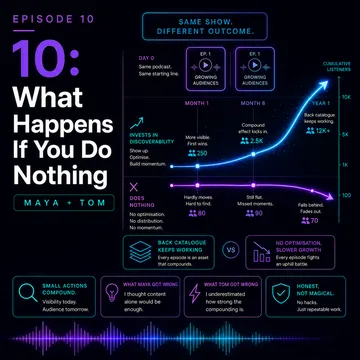
10: What Happens If You Do Nothing

The season finale of "How to Get Discovered" confronts the "invisible cost" of neglecting podcast discoverability, illustrating how Show A, investing in transcripts and data analysis, significantly outpaces Show B, which does nothing. After 12 months, Show A's back catalog actively generates new listeners through search, while Show B's audience stagnates, missing substantial growth opportunities. Maya self-corrected on three points, admitting she underestimated the effort for discoverability, found AI chatbots noisier than expected for content surfacing, and sometimes prioritized SEO over engaging titles. Tom also acknowledged his initial dismissal of transcripts and his defensive eye-rolling at podcast SEO, realizing loyalty and acquisition are not mutually exclusive. He now recognizes the back catalog as an undervalued asset, not just an archive. Tom's journey from skeptic to believer culminated in his upgrade to PodHerd's advanced tier, integrating with Search Console and setting up a CNAME. The hosts conclude Season 1 by urging listeners to activate their back catalogs, transforming past work into an ongoing asset that continues to earn new audiences.
Compounding
Episode 9

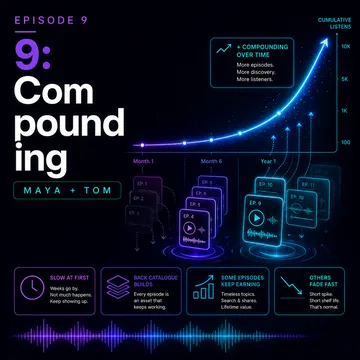
9: Compounding

The "How to Get Discovered" podcast hosts revealed initial disappointment with their three-week discoverability experiment, despite Google indexing transcripts. Data showed only tiny, single-digit results, challenging expectations for immediate impact. This early feedback underscores the long-term nature of compounding effects in podcasting, where back catalogs gain value over years rather than weeks. Podcast discoverability relies on the compounding effect, where older episodes can accrue more monthly listens years after release than during their initial launch, contrasting with front-loaded listenership models. Cohort analysis helps evaluate this by tracking episode groups, revealing that discoverability-focused shows maintain listenership at a declining but non-zero rate. Newsjacking episodes, while generating short-term spikes, do not compound like evergreen content. Clip-driven listens, shared personally, offer another compounding curve, independent of search trends. Longer clips, such as 5-15 minutes, are crucial for deep listener acquisition, allowing full evaluation before subscription. One host reflected on 350 episodes over 10 years, acknowledging significant dormant value due to past inaction on discoverability, now accepting new tools can leverage this content. The upcoming season finale will explore the consequences of investing in discoverability versus inaction, featuring a year in the life of two hypothetical shows and revisiting key disagreements from the season.

Under the Hood
Episode 8

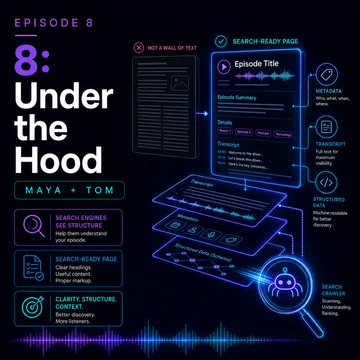
8: Under the Hood

The podcast "How to Get Discovered" unveiled the critical differences between a basic show notes page and a technically structured transcript page for search engine indexing. Google and Bing interpret webpages through underlying structure, not visual layout, prioritizing metadata and structured data like Schema.org to understand content purpose, which is often overlooked by standard podcast hosting platforms. Search engines require structured transcripts with headings and timestamps to create "addressable moments," allowing users to land directly on specific episode segments. Domain authority significantly impacts search performance; hosting transcripts on a custom domain via a CNAME record ensures search authority accrues to the podcaster's property, unlike platform-hosted subdomains. Google Search Console offers vital data on search queries and click-through rates, accessible only for controlled domains. One host initiated a personal experiment with PodHerd's starter tier to test these discoverability claims, aiming to collect three months of data. The hosts emphasized the importance of their personal PodHerd experiment, which will directly inform future discussions on compounding and long-tail traffic. This season finale sets the stage for data-driven insights into how back catalogs perform over time.

The Question Behind the Query
Episode 7

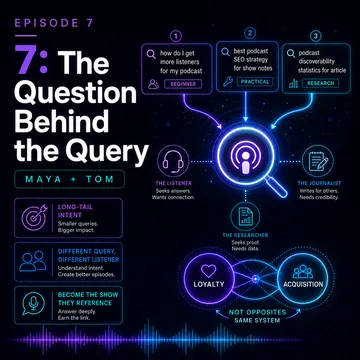
7: The Question Behind the Query

The podcast "How to Get Discovered" introduces its latest episode, "The Question Behind the Query," which delves into the philosophical aspects of podcast discoverability. This episode explores long-tail search intent, how podcasts become reference material for journalists and researchers, and the relationship between listener loyalty and acquisition. Understanding listener intent is crucial for attracting and retaining an audience. Hosts analyze three distinct search queries related to freelancing to illustrate different listener intents, such as "How do I negotiate my freelance rate without sounding desperate?" or "Best podcast for freelancers UK." This analysis categorizes listeners into "one-clip," "subscribe-or-not," and "authority" types, each requiring a tailored approach for discoverability. The episode emphasizes a podcast's role as a citable authority within its niche, influencing journalists and researchers who use similar search tools. The discussion challenges the common perception that loyalty and acquisition are opposing goals, asserting that loyalty naturally follows effective acquisition. The focus shifts from optimizing for initial download spikes to attracting "stay listeners" who are more likely to become loyal, rather than "bounce listeners" seeking only quick tips. This refined strategy prioritizes long-term listener retention over short-term metrics.

Stop Writing Bad Show Notes
Episode 6

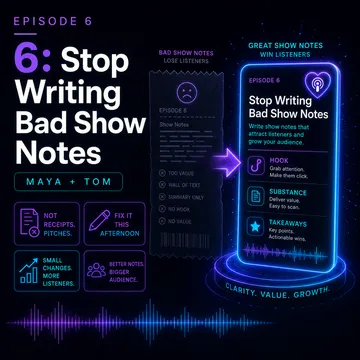
6: Stop Writing Bad Show Notes

Podcast creators are urged to rethink show notes, moving from simple labels to compelling pitches for new listener discoverability. Many podcasters, including one host who admitted to three years of "terrible, one-sentence show notes," often overlook these crucial elements, which serve as the second point of contact for potential new audiences after the episode title. An effective show note structure is proposed, featuring a three-paragraph format: a hook for strangers, detailed substance covering three to four specific topics for search engines, and guest credibility. This method, taking 15 minutes per episode, has demonstrably increased new listener engagement. Episode titles should be descriptive, avoiding "cute," "lazy," or "keyword-stuffed" approaches. Optimizing podcast metadata, including niche subcategories, is critical for app visibility. Multilingual transcripts are highlighted as a key strategy for global audience reach, leveraging AI chatbots to bridge language barriers and provide a competitive edge. The episode also previews "The Question Behind the Query," next week's topic, which will explore long-tail search intent and how podcasts can position themselves for reference by journalists and researchers. The hosts emphasize writing for the stranger, trusting regular listeners to adapt to more descriptive titles.

The Loyalty Trap
Episode 4

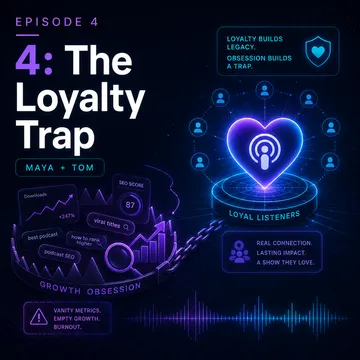
4: The Loyalty Trap

The podcast "How to Get Discovered" introduces "The Loyalty Trap" episode, where Tom argues that prioritizing new listener acquisition through SEO and discoverability tactics detracts from creating content loyal listeners truly love. He contends that the industry's focus on growth tactics like optimized thumbnails and cross-promotion often leads to well-marketed but mediocre shows, as resources are diverted from content quality. Tom asserts that lasting audiences grow through trust and word-of-mouth recommendations, driven by genuinely good content, rather than costly growth tactics that consume time and energy. The hosts debate how new listeners find podcasts, acknowledging word-of-mouth but also highlighting search as a critical entry point for "cold listeners" using "long-tail" queries. Listener-driven clips, distinct from host-cut marketing clips, are presented as a superior method for sharing specific "moments" or "exchanges." PodHerd is introduced as a tool enabling longer, more engaging listener-created clips, up to 5 or 15 minutes, for sharing entire arguments. The discussion refines the loyalty versus discoverability argument, concluding that search can be a pathway to loyalty and listener-driven clips a mechanism for word-of-mouth. However, the core principle remains that these tools must not compromise show quality, warning that growth tactics can still "eat the show" if not carefully managed.

Whose House Are You Building
Episode 2

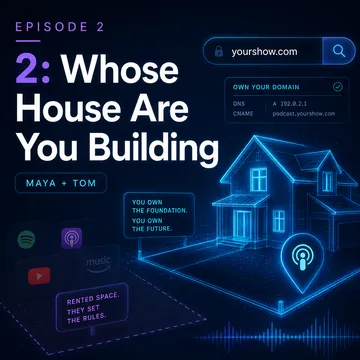
2: Whose House Are You Building

Maya and Tom, hosts of "How to Get Discovered," introduce the critical importance of a podcast's transcript URL for discoverability in their episode "Whose House Are You Building?" They emphasize that owning a podcast's domain, rather than relying on platforms like Spotify or Apple, provides stability and control, making podcasters less vulnerable to external platform changes. The episode highlights Podcaster A, who hosts show notes and transcripts on their own domain, as a model for maintaining control and accruing search authority. In contrast, Podcaster B, relying on subdomains, faces risks from platform shifts. Services like PodHerd are introduced for automating transcript creation from RSS feeds and structuring them into searchable web pages. The use of CNAME records allows podcasts to host content on services like PodHerd while their custom domain accrues SEO equity. Integrating with Google Search Console offers crucial data on search queries and ranking, available only to domain owners. Descriptive episode titles and comprehensive show notes, including key points and guest introductions, are vital for discoverability and engagement across podcast apps. The hosts preview an upcoming discussion on AI search, specifically ChatGPT's impact on podcast discoverability, questioning how podcasts will be found or cited as chatbot usage increases. One host predicts current AI search methods will seem quaint within three years.

Invisible Shows
Episode 1

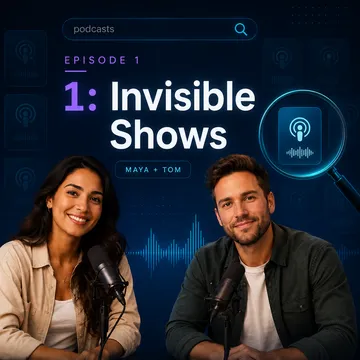
1: Invisible Shows

The "Invisible Shows" episode of "How to Get Discovered" tackles the critical issue of podcast discoverability, with hosts Maya and Tom debating whether content quality or search optimization is paramount for new listener acquisition. They highlight how niche, high-quality podcasts often remain unseen by potential audiences actively searching for specific topics like "beekeeping for beginners," leading to a significant missed opportunity for growth. Podcast episodes quickly become buried in feeds, limiting their lifespan despite being evergreen content. Maya, from a content marketing background, argues that a podcast's back catalog is a valuable asset, not just an archive, citing an episode on negotiating freelance rates that remains relevant years later but is hard to find. Tom, a veteran podcaster, acknowledges word-of-mouth but emphasizes the limitations. The discussion points out that raw transcripts are insufficient for search engines; tools like PodHerd are now essential for proper indexing and structuring to make older content searchable by Google, attracting "search-shaped listeners" who have specific questions. This installment of "How to Get Discovered" features Maya and Tom's engaging disagreements, aiming to determine who is "more right" over their ten-episode arc. The thought experiment about finding a beekeeping podcast effectively illustrates the core problem of content invisibility.