
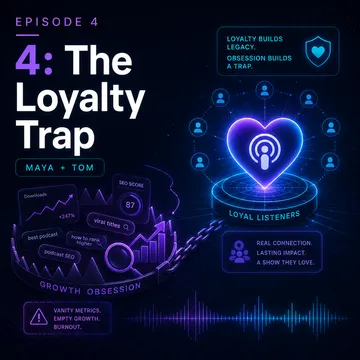
Episode 4 · Tuesday, 31 March 2026

The Loyalty Trap

Discoverability tactics often compromise content quality, argues Tom, who champions listener loyalty and authentic word-of-mouth growth over SEO-driven listener acquisition.

By How To Get Discovered | 16m listen | 7 chapters
The Loyalty Trap cover
How To Get Discovered · No. 4

About this episode

The podcast "How to Get Discovered" introduces "The Loyalty Trap" episode, where Tom argues that prioritizing new listener acquisition through SEO and discoverability tactics detracts from creating content loyal listeners truly love. He contends that the industry's focus on growth tactics like optimized thumbnails and cross-promotion often leads to well-marketed but mediocre shows, as resources are diverted from content quality.

Tom asserts that lasting audiences grow through trust and word-of-mouth recommendations, driven by genuinely good content, rather than costly growth tactics that consume time and energy. The hosts debate how new listeners find podcasts, acknowledging word-of-mouth but also highlighting search as a critical entry point for "cold listeners" using "long-tail" queries. Listener-driven clips, distinct from host-cut marketing clips, are presented as a superior method for sharing specific "moments" or "exchanges." PodHerd is introduced as a tool enabling longer, more engaging listener-created clips, up to 5 or 15 minutes, for sharing entire arguments.

The discussion refines the loyalty versus discoverability argument, concluding that search can be a pathway to loyalty and listener-driven clips a mechanism for word-of-mouth. However, the core principle remains that these tools must not compromise show quality, warning that growth tactics can still "eat the show" if not carefully managed.


CHAPTER 01 / 7 Discussion

The Loyalty Trap: Podcast Growth vs. Listener Love

The podcast "How to Get Discovered" introduces "The Loyalty Trap" episode, where Tom argues that chasing new listeners through search and discoverability is a distraction from making a show loyal listeners truly love. He contends that the industry has prioritized growth tactics like SEO, thumbnails, and cross-promotion, leading to well-optimized but mediocre shows, as energy is diverted from content quality.

loyalty trap· podcast industry· podcast growth· discoverability· listener love· optimization· mediocrity

00:00 Welcome back to How to Get Discovered. I'm Maya And I'm Tom HTGD is the show where we argue about how podcasts get found Last week, we did the AI episode and ended in a slightly philosophical place Today's episode is going to be less philosophical Today's episode is the one where Tom finally gets a full hour to make his case against me That's about time. It's the episode we're calling The Loyalty Trap. The argument is, chasing new listeners through search and discoverability is mostly a distraction for making a show that loyal listeners actually love. That's my argument And my job is to push back on it — which I will — but I want to give you the floor for this one so Tom make the case With pleasure Okay...I wanna start by being a little provocative

00:49 I think the podcast industry, or the bit of it that talks about podcasting on podcasts and on Twitter and on LinkedIn has spent the last five years getting the priorities backwards. There has been a vast amount of conversation about how to grow, how to get found, how to scale, how to optimize. And there's been almost no conversation about how to make a show that people listening to it actually love! That is a big claim It's a big claim. And I want to defend it for the next 25 minutes, because I think there is a category of podcaster—and I have been this podcaster—who optimizes their way into mediocrity

01:30 They obsess over titles, they obsess over thumbnails. They obsess over SEO and metadata. They cross promote on other shows, they run ads, they post clips...they do all the things you're supposed to do and the show gets worse! Why does the show get worse? Because the attention is in the wrong place because the energy that should go into preparing better asking better questions editing tighter going deeper That energy is going into infrastructure and growth tactics And what you end up with is a well-optimized, mediocre show. That's a worldview! That's a worldview and the alternative worldview which is the one I want to defend Is that you should put everything into making the show better for people who are already listening Trust that those people will tell other people Trust that depth beats breadth Trust that the show grows when it deserves to grow Ignore — actively ignore most of the discoverability conversation

CHAPTER 02 / 7 Discussion

Word-of-Mouth Growth and the Cost of Growth Tactics

Tom asserts that podcasts with meaningful, lasting audiences grow through trust and word-of-mouth recommendations, driven by genuinely good content. He argues that growth tactics, such as SEO and metadata optimization, are not free; they consume time and energy that should be spent on improving the show, ultimately making the content worse and alienating loyal listeners.

word-of-mouth· podcast growth· loyal listeners· growth tactics· show quality· discoverability

02:29 Okay, I am gonna disagree with that. But you've made it well. Go on So let me give the affirmative case Not just the other thing is bad but this thing is good Please The way podcasts actually grow The way real shows—the ones that last The ones that have meaningful audiences ten years in They grow through trust Somebody listens, and they like the host. And they tell their friend The friend listens The friend likes the host The friend tells another friend It's slow... it's not linear… it has compounding effects but they're not the kind of compounding effects you see on a dashboard

03:14 They show up over years. Right? And the engine that drives that, the only engine that drives that is the show being good — genuinely good The kind of good where somebody finishes an episode and thinks I want to send this to someone That's the only marketing that matters. Everything else is adjacent I'm with you so far And the loyalty trap The reason i called this episode the loyalty trap Is the thing podcasters do when they get scared that loyalty isn't enough They look at the numbers, the numbers are not growing fast They get anxious They start chasing new listeners through tactics and the tactics

03:56 The better titles, the SEO, the metadata, the search-friendliness. They take time. They take attention and that attention has to come from somewhere and you think it comes from the show? I think it comes from the show! I think you have a finite amount of energy for a podcast that is mostly a side project And every hour you spend on growth tactics is an hour you didn't spend reading more deeply, preparing a better question, editing a tighter cut. The show gets worse and the loyal listeners notice. They don't say anything but they notice This is your real argument isn't it? This is my real argument That growth tactics aren't free They're not just a thing that you do on top of the show

04:46 They cost you the show. Okay, I'm going to take that seriously because I think you're right about the failure mode—I have seen podcasters do exactly what you're describing. There is a version of obsessing over discoverability that genuinely makes the work worse. Thank you! But... But? I don't think the conclusion is ignore discoverability, but something more like be ruthless about which discoverability things actually matter and not let them eat the show That's a more reasonable position than the strawman version in my head

CHAPTER 03 / 7 Discussion

Search-Driven Discoverability and Long-Tail Questions

The hosts debate how new listeners find podcasts. While word-of-mouth is acknowledged as important, the argument is made that search is an increasingly significant entry point for "cold listeners" who have specific questions. These listeners often use "long-tail" search queries, and episodes that answer these specific questions can attract highly engaged individuals who are more likely to subscribe.

search discoverability· new listeners· word-of-mouth· long-tail search· specific questions· podcast growth

05:29 The strawman version of me in your head sounds like an SEO consultant. It does, the real you keeps surprising me! Okay now I want to push back because while i think your case is real... ...I also think it has a hole in it and the hole is how do listeners find the host they're going to be loyal to in the first place? Word-of-mouth. Word-of-mouth is one route. It's an important route but it's not the only route And for most shows, it's not even the dominant route. Especially not the dominant route for new listeners. Define new listener? Somebody who has never heard of you, has no friend who has recommended you, and has no algorithmic exposure to you

06:11 The cold listener. The one who doesn't know the show exists." Right! That listener has to enter the funnel somewhere, and in 25, 26...the way that listener increasingly enters is through search—not the homepage of a podcast app, not a list of best podcasts in some magazine. They have a question. They type the question into something. They land on a result. The result is a moment from a podcast episode And that's the bit I'm not sure about. Go on? I'm not sure that's actually how most people find new shows, I think most people find new shows because somebody they trust a host, a podcast they already listen to, a friend mentions one

06:58 The search-driven path you're describing is real, but I think you overestimate how big it is. Maybe...but it doesn't have to be the dominant path for it to matter —it just has to be a non-trivial path Because every listener who finds you via search is a listener you would otherwise not have had. And those listeners aren't replacing your word-of-mouth listeners, they're additive." Sure! And here is the bit that I think is the actual argument The listener who finds you via search? They're not typing good podcasts They are typing a specific question How do I negotiate a freelance rate What's the difference between a sole trader and limited company

07:41 Why does my dog do this weird thing? Specific, question-shaped. And the way they phrase it tells you something about what they're actually looking for." Long tail. Long tail… right! The big head terms—tech podcast, comedy podcast—those are unwinnable. You don't compete on those. But the long tail of specific questions Those are winnable. Because most podcasts have at least one episode that genuinely is the answer to a specific question somebody might Google." And your argument is that if you make those episodes find-able, you get those listeners? And those listeners are — and this is the bit I think you'll like — they're not casual listeners. They came to your show with a specific question. They got an answer. They're disproportionately likely to subscribe

CHAPTER 04 / 7 Discussion

Word-of-Mouth Infrastructure: Shareable Moments and Clips

The discussion shifts to the infrastructure needed for effective word-of-mouth growth. It's argued that simply having an MP3 and a feed creates too much friction for recommendations. Instead, listeners want to share specific "moments" or "exchanges" from a podcast, such as clips dropped into group chats, rather than just recommending a show by name.

word-of-mouth· shareable moments· podcast clips· friction· mp3· group chat

08:33 Because they sought you out. A listener who entered through a long tail search is, in my experience more likely to become a loyal listener than one who entered through a chart placement That's actually an interesting claim because the implication is that search isn't competing with loyalty Search is feeding loyalty That's the claim I'm gonna think about that Now, here's the bit I really want to get to. Because I want to come back to your central claim which is that word of mouth is the real engine It IS the real engine! I agree…I want to agree with you about that more loudly than I have so far Word-of-mouth is the REAL engine Where's the trap? The trap is – and this is the bit I think gets missed – word of mouth needs infrastructure

09:24 It doesn't happen on its own. If your show only exists as an mp3 and a feed, then the only way somebody can recommend it is to say you should check out this podcast called X which is attacks on the recommender they have to remember the name they have to type it The friend has to find the show The friend has to download an episode The friend has to start at the right place That's a lot of friction Okay Whereas what people actually do when they want to recommend a podcast is they want to send the bit, the moment, the exchange that made them laugh or made them think. They want to drop a clip into a group chat. They wanna send a 30-second voice memo to a friend that says listen to this... That's how word of mouth happens in 2026—it happens through shareable moments not through check out this podcast called X

10:17 And most podcasts have no shareable moments. Most podcasts have nothing to share, they have an mp3. The listener can what copy a link to the episode? Tell their friend skip to 47 minutes in that's not a share that's a homework assignment This is why I think clip generation matters Not as a vanity feature As infrastructure for the word of mouth you already believe in Because if a listener can pull out the 90-second exchange that made them want to recommend you and just send it as a video with the audio, with the transcript overlay... That's the moment that travels. The clip is the show. Define clip generation because I have a slightly negative association with the phrase from a couple of years of seeing it abused Fair

CHAPTER 05 / 7 Discussion

Listener-Driven Clip Generation vs. Host-Cut Clips

The concept of "clip generation" is clarified, distinguishing between host-cut clips for marketing and listener-driven clips. Listener-driven clips allow the audience to highlight and share specific passages from a transcript as video clips, complete with audio and attribution. This method is seen as superior because listeners have better instincts about what is shareable and it doesn't incentivize hosts to perform for clips.

listener-driven clips· host-cut clips· clip generation· shareable content· podcast marketing· TikTok

11:09 So what I mean is, the listener—the actual listener. Not you not me—opens the show page They see the transcript they highlight the bit they want They share it as a video clip The clip carries the audio, the words on screen attribution back to the show The friend who receives it can watch the clip and if they like it click through and find the full episode The listener didn't have to do anything more than highlight a passage and tap share The host, you didn't have to make a clip for them. The clip is generated from the moment they chose That's not what I usually mean when i hear clip... I know! What you usually hear is the host cutting their own clips. The host or production team taking what they think is best 90 seconds and putting it on TikTok

11:59 Which is a different thing. That's the host marketing the show, what I'm describing is the listener doing it The listener has better instincts about what's shareable than you do by the way because they know which bit made them want to share That is annoyingly true It's true Okay...I am going to actually take this seriously for a minute Because the version of clips I have negative associations with is the host cutting their own clips version, which i have not enjoyed watching shows do. Because it leads to... you can feel the show being recorded with the clip in mind. Hosts performing for the clip, arguments staged for the clip It's the worst thing. But the listener-driven version is different

12:48 Because the listener can only clip what was already there. They can't make the show change, they can only surface what the show actually was which means that host can keep making the show they were going to make and audience can do surfacing work themselves That's it! That is exactly the point Listener driven clipping doesn't change what you record It just makes recording portable Now I have a practical question Go How long can a clip be? Because the bit I want a friend to send me is usually not 30 seconds. The 30 second clip is...I don't trust thirty-second clips. The thirty second clip is what TikTok pulled out of context

CHAPTER 06 / 7 Discussion

PodHerd and Longer Podcast Clips for Deeper Engagement

The discussion highlights the limitations of short, TikTok-style clips (30-60 seconds) for genuine word-of-mouth sharing. It introduces PodHerd, a tool that allows listeners to create longer clips, up to 5 or 15 minutes, enabling the sharing of entire arguments or segments. This approach is considered more effective for capturing and sharing content that truly resonates with listeners.

podherd· podcast clips· long clips· segment sharing· listener engagement· TikTok defaults

13:30 The bit I want to send a friend is usually a whole argument. Five minutes, sometimes more! The exchange where two people actually disagree about something and work it through This is the thing...the defaults on most clip tools are short 30 seconds 60 seconds built for TikTok Built for the algorithm And those clips are fine for what they are But they're not the clips your audience actually wants to send each other Right The clip a real listener wants to send is the full bit, the whole argument. The setup and the payoff which means it needs to be longer than the TikTok default. PodHerd—I'll mention it because its relevant—lets listeners pull clips up to 5 minutes on the standard tier and 15 minutes on the higher tier

14:18 Which sounds like an arbitrary distinction until you start thinking about what a 15-minute clip actually is. A 15 minute clip is a full segment of a podcast, it's a whole conversation—it's not a soundbite! A 15 minute clip is basically a short episode And the thing that makes it interesting is…you didn't decide what the short episode is—the listener did Which means it's the bit that genuinely resonated with somebody, which means it's the bit that is actually likely to resonate with the friend they send it too. That's a more interesting feature than I thought when you started It's because you came in with the wrong mental model! I came in with the wrong mental model This is where I get to be smug

CHAPTER 07 / 7 Discussion

Refining the Loyalty vs. Discoverability Argument

The hosts conclude by refining the initial argument that loyalty matters more than discoverability. They agree that search can serve as a front door to loyalty, and listener-driven clips can be a mechanism for word-of-mouth. However, the core position remains that these tools should not detract from making a quality show, acknowledging that growth tactics can still "eat the show" if not managed carefully. The next episode will focus on evergreen content and the "back catalog."

loyalty· discoverability· search· word-of-mouth· podcast growth· refinement

15:02 This is the bit where you get to be smug. I will allow it for 30 seconds now, I want to land this episode honestly because I came in to make the case that loyalty matters more than discoverability and I still believe that You should still believe that but what you've done and i'm being more generous than usual here don't get used to It what you've done is convince me That those things are not opposed in the way. I thought they were search can be the front door to loyalty Clips can be the mechanism for word of mouth. They can be they can be they can also be the thing that eats the show So I'm not changing my position. I'm refining it Refining is fine Refining is what I'm doing next week next week

15:53 Next week we're doing the episode that won't die. The evergreen episode story, the one where an episode from three years ago suddenly starts getting traffic and the Bat Catalog starts to compound I am going to bring skepticism of any case study with the word suddenly in it You always do Thanks for listening to How To Get Discovered We'll see you next week See ya next week