
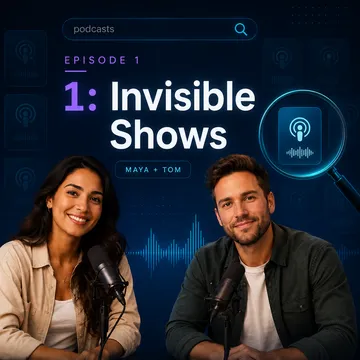
Episode 1 · Tuesday, 10 March 2026

Invisible Shows

New listeners struggle to find quality podcasts, even when searching for specific topics, making many shows effectively invisible to their target audience.

By How To Get Discovered | 14m listen | 6 chapters
Invisible Shows cover
How To Get Discovered · No. 1

About this episode

The "Invisible Shows" episode of "How to Get Discovered" tackles the critical issue of podcast discoverability, with hosts Maya and Tom debating whether content quality or search optimization is paramount for new listener acquisition. They highlight how niche, high-quality podcasts often remain unseen by potential audiences actively searching for specific topics like "beekeeping for beginners," leading to a significant missed opportunity for growth.

Podcast episodes quickly become buried in feeds, limiting their lifespan despite being evergreen content. Maya, from a content marketing background, argues that a podcast's back catalog is a valuable asset, not just an archive, citing an episode on negotiating freelance rates that remains relevant years later but is hard to find. Tom, a veteran podcaster, acknowledges word-of-mouth but emphasizes the limitations. The discussion points out that raw transcripts are insufficient for search engines; tools like PodHerd are now essential for proper indexing and structuring to make older content searchable by Google, attracting "search-shaped listeners" who have specific questions.

This installment of "How to Get Discovered" features Maya and Tom's engaging disagreements, aiming to determine who is "more right" over their ten-episode arc. The thought experiment about finding a beekeeping podcast effectively illustrates the core problem of content invisibility.


CHAPTER 01 / 6 Discussion

How to Get Discovered Podcast Introduction and Format

"How to Get Discovered" is a weekly podcast hosted by Maya and Tom, focusing on podcast growth, search, and discoverability. Maya, with a background in content marketing, emphasizes the importance of discoverability, while Tom, a veteran podcaster, prioritizes making a good show. The format involves discussing a topic, often disagreeing, with a goal to determine who is "more right" over ten episodes.

how to get discovered· podcast growth· search· discoverability· content marketing· podcasting industry

00:00 Hello and welcome to How to Get Discovered. I'm Maya And I'm Tom HTGD is a weekly conversation about podcast growth, search, discoverability and all the unglamorous mechanical stuff that decides whether anyone outside your existing audience ever finds your show Which Maya thinks is the most important thing in podcasting I do And which I think is mostly a distraction from making a good show Which is why we're doing this podcast together Quick introductions because it's episode one. Maya came up through content marketing before she got into podcasts, which is relevant because she still thinks like a content marketer. Every episode is an asset every asset should compound nothing has ever finished and Tom has been making podcast for 10 years Which is relevant because he has watched every fad in this industry come and go And he is skeptical of basically all of them accurate

00:56 The format of the show is simple. Each week we pick a topic, we disagree about it... sometimes we change each other's minds…sometimes we don't! The plan is 10 episodes and by the end of those ten episodes one of us is going to be more right than the other It's gonna be me We'll see Today's episode is called Invisible Shows. It's the one where I try to convince Tom, and you that most podcasts are basically impossible to find unless you already know about them and that this is a much bigger problem than the industry pretends And I'm gonna push back on that because I think the problem is real but smaller than Maya thinks and the solutions are usually worse than the problem Let's get into it!

CHAPTER 02 / 6 Discussion

Invisible Shows: The Podcast Discoverability Problem

The episode "Invisible Shows" explores the challenge of new listeners finding podcasts without prior knowledge. A thought experiment illustrates that someone searching for a niche topic, like "podcast about beekeeping for beginners," is unlikely to find smaller, high-quality shows, instead discovering only established ones. This highlights the core problem of podcasts being "invisible" to potential new audiences.

invisible shows· podcast discoverability· search· beekeeping podcasts· new listeners· content visibility

01:41 I want to start with a thought experiment. Oh no! No, you'll like this one Imagine someone – let's call her Sarah – is going on a long drive tomorrow She has never heard of your show and she has never heard of my show She is gonna type something into her phone or ask for her car Or open up a podcast app and search for something to listen too What does she search for? Depends what she's interested in. Right, so say she is interested in... I don't know beekeeping New hobby She just got her first hive Okay She types podcast about beekeeping for beginners into something Does she find your show My show isn't about beekeeping Tom! I know what you mean Fine If my show were about beekeeping

02:31 Probably not, no. She'd find the big ones—the ones with names she's already heard And that's the entire problem we're talking about for the next 30 minutes Because there are probably hundreds of brilliant beekeeping podcasts out there Maybe even one that is perfect for Sarah and she will never ever find them because podcasts are invisible That's the show. We can end it there? We could, but you'd disagree with me and the audience came for the disagreement They did They really did. Okay, let me lay it out properly When you publish a podcast episode what actually happens? You upload an mp3 to your host Your host pushes it to Apple Spotify Overcast whatever People who already subscribe get a notification The episode goes into the feed and then And then it lives there forever

CHAPTER 03 / 6 Discussion

Podcast Episode Lifespan and Word-of-Mouth vs. Discoverability

Podcast episodes, once published, quickly sink in feeds, becoming difficult to find for new listeners. While word-of-mouth is acknowledged as a valid growth strategy, it has limitations. The discussion emphasizes that every episode is evergreen content that could attract new listeners if discoverable, contrasting with the view that discoverability efforts are a distraction from content quality.

podcast episodes· evergreen content· word-of-mouth· discoverability· SEO· audience growth

03:27 In theory. In theory? In practice, it sinks! The next episode comes along and pushes it down the list Three months later, it's 20 episodes deep A year later, it's so far down nobody scrolls that far Sure but the people who care listened That's the whole point The episode did its job That's exactly where I want to push back Because here's the thing. The episode did its job for the people who already knew about you, the audience you already had… but every episode you make is also a piece of evergreen content that could—in theory—be discovered by people who don't know you exist yet and almost none of them are going to find it because there's nothing for them to find! The MP3 is sitting on a server somewhere

04:16 Google can't read it. ChatGPT can't read it. Nobody can read it! It's invisible." This is the bit where I push back, please? I've been doing this 10 years and in ten years the shows that have grown really grown not just chart spikes have grown because they were good word of mouth someone tells someone The host goes on another podcast a listener becomes a recommender That's how it works. That's how it always worked, and I think the SEO and discoverability stuff is mostly noise that distracts people from making the show better." Okay two things first I'm not arguing against word of mouth Word-of-mouth is real It's how my show grew too for years But word-of-mouth has a ceiling its scales with the number of evangelists you have and Evangelists are rare

05:11 The question is, what do you do for everyone who isn't already evangelizing you? Make a better show so they will. But how do they find the show in the first place to decide whether to evangelize it? Hmm. Right, that's the gap! That's where every podcaster I know is leaving listeners on the table because you've made the show—you've already done the hard work. The episodes exist—they're sitting there and the only thing standing between those episodes and a new listener is can they be found Okay, but can they be found is a much smaller problem than the SEO industry wants you to believe. Most podcasters I know who chase this stuff spend more time on metadata than on writing and their shows don't get better—they just get more anxious! That's fair and I'll concede that there is a version of this conversation that turns people into bloggers who happen to record audio. I do not want that either but that's a failure mode not the whole game

CHAPTER 04 / 6 Discussion

Back Catalog as an Asset, Not an Archive

The concept of a podcast's back catalog is reframed from a mere archive to a valuable asset. An example of an episode on negotiating freelance rates, still relevant two years later, demonstrates that useful content goes unheard because its position in the feed makes it "old." This highlights the missed opportunity for new listeners searching for specific information.

back catalog· podcast archive· evergreen content· freelance rate negotiation· content utility· discoverability

06:11 There's a version where the work you've already done, the episodes, the interviews, the conversations gets a second life without you doing anything different to the show itself. That's the part I'd want to hear more about So this is what i want to get into The back catalog because I think most podcasters think of their back catalogue as an archive A historical record Old episodes And I want to convince you and the listener that your back catalogue is an asset Not an archive. Okay, give me the version of that argument that doesn't sound like a LinkedIn post? Fair... So pick an episode from your show from two years ago—any episode! Was it any good? Some of them… sure Pick a good one Alright there's one about how to negotiate a freelance rate

07:04 Came out really well. Perfect! Is that conversation any less true today than it was two years ago? No, if anything more relevant... Right! So you have a piece of content that's still useful, still relevant, still good and how many people listened to it when it came out? Whatever my audience was at the time And how many people are listening to it this week? Almost none Why?! Because it's old But you just said the content isn't old. The conversation isn't old, the advice in it isn't old...the only thing that's old is its position in the feed Yeah So you've got a brilliant conversation about freelance rate negotiation and somewhere in the world this week there was a freelancer googling how do I negotiate my rate And your episode does not come up because Google has no idea your episode exists

CHAPTER 05 / 6 Discussion

Transcripts for Search: Beyond a Wall of Text

Simply having transcripts is insufficient for search engine discoverability; their structure and placement are crucial. A "wall of text" under an embedded player is not effectively searchable by Google, which struggles to understand specific moments or topics within it. Tools like PodHerd are now available to properly transcribe, index, and structure episodes, allowing older content to gain search traffic.

podcast transcripts· search engine optimization· show notes· embedded player· PodHerd· search traffic

07:57 It's an MP3. It's invisible! Okay, but I had transcripts... Did you? For some episodes yeah…I paid a service to transcribe them years ago. Cost me a fortune and nothing happened Where did those transcripts live? On my show notes page under the player One long blob of text No structure, no timestamps, no episode-specific URL? Probably. That's the thing! Having a transcript and having a transcript that works for search are two completely different things. A wall of text under an embedded player isn't a searchable document—it's a blob

08:38 Google can technically read it, but it can't understand what's in it. Can't surface specific moments—can't tell that this paragraph is about rate negotiation and that paragraph is about client onboarding. To a search engine your transcript page was basically one giant noun This is starting to feel like the part where you tell me I should have done something different. It's the part where I tell you that you weren't wrong, you were just early The tools to do it properly didn't really exist when you tried They exist now I'll give you a concrete example. I put my show through PodHerd about, I think it's eight months ago now. Every episode transcribed indexed structured properly each moment with its own URL and the thing that surprised me wasn't the new episodes It was the old ones Episodes from years ago started getting search traffic

CHAPTER 06 / 6 Discussion

Search-Shaped Listeners and the Podcast Funnel

The discussion introduces the concept of "search-shaped listeners" who have specific questions and actively seek answers, contrasting them with "browsing listeners" who desire company or a trusted host. It is argued that search serves as the top of the podcast funnel, leading new listeners to specific episodes, and if they like the host, they become loyal "browsers." Many podcasters have neglected this top-of-funnel discoverability.

search-shaped listeners· podcast funnel· browsing listeners· loyalty· top of funnel· discoverability

11:12 I think about it like this. Right now, today there is somebody searching for the exact thing your show is about They have the question you have the answer You recorded the answer two years ago They're gonna find an answer somewhere. The only question is whether it's yours or somebody else's." That's a good line! It is, isn't it? But here's where I push back... You're describing a search-shaped listener—someone with a specific question looking for a specific answer—and I don't think most podcast listeners are that person. Most podcast listeners are commuters and dog walkers and people doing the washing up

11:52 They're not searching. They're browsing! They want company, they want a host they trust. Okay yes most listening is browsing I'll absolutely give you that but how do those browsing listeners find the host they trust in the first place? They have to enter the funnel somewhere And I think for an enormous number of people now, that entry point is a search. They Google the question they land on an episode they listen to that one episode and if they like the host, they become a browser. They become the dog walker. They become loyal So you're saying search is the top of the funnel and loyalty is the bottom?

12:33 Yes. And what I think most podcasters have done is they've built the bottom of the funnel, the loyal listener experience beautifully and they've completely ignored the top They've got a wonderful living room with no front door That's annoyingly good Thank you But I'm still not entirely convinced I think the version of this conversation where the podcaster spends all week tweaking titles and metadata, and never actually makes a better show is a real risk. And I see it happen. I see it too. And I think that's a failure mode we should keep coming back to in this series None of this matters if the show is boring We agree on that completely —We do But the show isn't boring That's the premise