Episode 2 · Tuesday, 17 March 2026

Whose House Are You Building

Discover how owning your podcast's domain and optimizing transcripts with CNAMEs and Google Search Console are crucial for long-term discoverability and audience growth.

By How To Get Discovered | 17m listen | 9 chapters
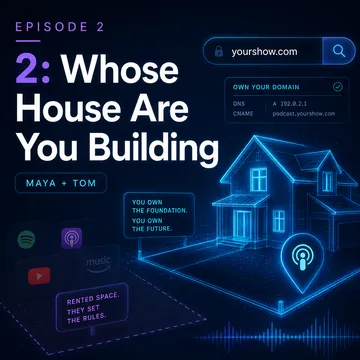
Whose House Are You Building cover
How To Get Discovered · No. 2

About this episode

Maya and Tom, hosts of "How to Get Discovered," introduce the critical importance of a podcast's transcript URL for discoverability in their episode "Whose House Are You Building?" They emphasize that owning a podcast's domain, rather than relying on platforms like Spotify or Apple, provides stability and control, making podcasters less vulnerable to external platform changes.

The episode highlights Podcaster A, who hosts show notes and transcripts on their own domain, as a model for maintaining control and accruing search authority. In contrast, Podcaster B, relying on subdomains, faces risks from platform shifts. Services like PodHerd are introduced for automating transcript creation from RSS feeds and structuring them into searchable web pages. The use of CNAME records allows podcasts to host content on services like PodHerd while their custom domain accrues SEO equity. Integrating with Google Search Console offers crucial data on search queries and ranking, available only to domain owners. Descriptive episode titles and comprehensive show notes, including key points and guest introductions, are vital for discoverability and engagement across podcast apps.

The hosts preview an upcoming discussion on AI search, specifically ChatGPT's impact on podcast discoverability, questioning how podcasts will be found or cited as chatbot usage increases. One host predicts current AI search methods will seem quaint within three years.


CHAPTER 01 / 9 Discussion

How to Get Discovered: Whose House Are You Building?

The "How to Get Discovered" podcast, hosted by Maya and Tom, introduces an episode titled "Whose House Are You Building?" The episode focuses on the critical importance of a podcast's transcript URL for discoverability and the mechanics of getting found. It promises a discussion on CNAMEs and their impact on podcast growth.

how to get discovered· podcast growth· search· discoverability· CNAME

00:00 Welcome back to How to Get Discovered. I'm Maya And I'm Tom HTGD is the show where we argue about podcast growth, search and the unglamorous mechanics of getting found Last week we did the case that most podcasts are basically invisible Today's episode is about where you're invisible from Which sounds like a riddle It is a bit. The episode is called Whose House Are You Building? It's the one where I try to convince you that the URL your transcripts live on matters more than almost anything else you do for discoverability And it's the one where I express opinions about a thing called a C name, which I promised last week I would do and which I now slightly regret. You're gonna love it! I am going to hate it Let's get into it

CHAPTER 02 / 9 Discussion

Podcaster A vs. Podcaster B: Owning Your Podcast's Home

A comparison is drawn between two podcasters: Podcaster A, who hosts their show notes and transcripts on their own domain, and Podcaster B, who relies on platforms like Spotify, Apple, or their podcast host's subdomain. The discussion highlights that Podcaster A, by owning their domain, maintains control and stability, making them less vulnerable to platform changes or failures compared to Podcaster B.

podcaster A· podcaster B· website ownership· Spotify· Apple· podcast hosting

00:51 Okay, I want to do a comparison. Two podcasters. Hit me. Podcaster A has been making a show for five years. They've got a website theirshowname dot com It's got an about page, a contact page and embedded player on the homepage Show notes for each episode hosted on the same domain Standard setup. Podcaster B has been making the same show for 5 years Same quality, same audience size. But Podcaster B's show notes are all hosted on Spotify or Apple or their podcast host's default subdomain something like myshow dot some hosting platform dot com Their own .com is barely used maybe redirects somewhere Also standard Maybe more standard actually Right Now Both podcasters have great episodes both have great content

01:45 Question, five years from now which podcaster is harder to put out of business? Hmm. Take your time. Podcaster A, because they own the thing Why? Because if Spotify changes its mind about something or Apple changes the rules or the hosting platform goes under or gets bought or rebrands, Podcaster B loses the home for everything they've ever made. Podcaster A still has the website Right! So you already agree with me we can end the episode We are not ending

02:20 ending the episode. We are not! So this is the thing I want to spend the first segment on, because i think every podcaster intuitively understands what you just said if you ask any podcaster do you want to own your audience or rent it they'll say own it obviously but almost nobody acts like that's true define acts like where do you publish? Where do your show notes live? Where do your transcripts live if Where does a listener go when they want more than the audio? For most podcasters, the answer is somebody else's website. The hosting platform's default page...the Spotify show page…the Apple page…maybe a link tree. A link tree is a brave thing to admit Nobody's admitting anything! But the point

03:11 Every time you direct a listener to an URL that isn't yours, you're putting another brick in somebody else's house. You're building their property not yours! Okay but devil's advocate most listeners don't care whose URL they are on They just want the episode The infrastructure is invisible to them True the listener doesn't care But the search engine cares The AI assistant cares And future-you cares Unpack Search Engine Cares. So, Google—and this is true of basically every search engine including the new AI ones—assigns a kind of trust score to domains. They don't call it that anymore. The SEO crowd used to call it domain authority…the term's slightly out-of-fashion but the concept isn't. The idea is...a domain that has been around for a long time —that has lots of other reputable sites linking to it, that publishes consistent content—that earns engagement

04:09 That domain accrues weight, and every page on that domain inherits some of that weight. So a new article on a high-authority domain ranks more easily than the same article on a brand new domain. Okay. Now think about where your transcripts live, if they live on your hosting platform's default subdomain say myshow dot somehostingplatform dot com they inherit the authority of that hosting platform but the platforms authority is spread across thousands of podcasts Your show is one of 10 000 and critically none of the authority is accruing to you

04:46 If you leave the platform in three years, you lose everything that page ever earned. You take your audio with you—you don't take the rankings." Right. Whereas if your transcripts live on your own domain —yourshowname dot com slash episode slash 47— every visit, every link, every time somebody shares that URL…the authority is accruing to YOUR domain...YOUR property forever Even if you change hosts, change networks, change everything. The domain stays yours This is the part I want to push on Please Because what you're describing is real But for most podcasters it's also overwhelming You're saying make your own website Host your own transcripts Build domain authority That's a project

CHAPTER 03 / 9 Discussion

PodHerd: Transcribing and Structuring Podcast Content

The discussion introduces services like PodHerd that automate the process of transcribing podcast episodes from an RSS feed, structuring them into searchable web pages, and publishing them. This technology simplifies the task of creating a comprehensive podcast website, a process that previously required significant development effort.

podherd· RSS feed· transcription· searchable pages· podcast tools

05:35 Most podcasters are running a podcast in their spare time. They already have the audio host, they already have the show notes filled in... You're describing a whole second job! That's a fair pushback and ten years ago I'd've agreed with you building your own site getting transcripts onto it structuring them properly keeping them in sync with your feed that was a real project It's not anymore Because... Because the tools have caught up. There are services now that will take your RSS feed, transcribe every episode, structure each transcript as its own searchable page and publish it The thing that used to take a developer and three months now takes pointing a service at your feed And you're gonna tell me PodHerd does this

CHAPTER 04 / 9 Discussion

CNAMEs and Domain Authority for Podcast Transcripts

The concept of using a CNAME record to host podcast transcripts on a service like PodHerd while maintaining a custom URL is explained. This setup allows the podcast's own domain to accrue search authority and equity, even though the content is technically hosted on the service's servers. This strategy ensures long-term discoverability and SEO benefits for the podcaster.

CNAME· domain authority· podherd.com· search ranking· podcast transcripts

06:22 Podherd does this. I'm not going to pretend otherwise, but I'd be making this argument even if Podherd didn't exist—the principle is older than the product! Noted. Okay, now I want to get into the part that I promised would make you have opinions about a C name. Embraced! So let's say you do the thing – go to a service like PodHerd or someone equivalent. You point it at your feed… It transcribes everything, structures everything, builds these beautiful searchable transcript pages for you. Now where do those pages live? On their website.

06:57 Right. By default, they live on something like podherd dot com slash your show name—which is fine! Better than nothing. Better than no transcripts at all. The pages get indexed, they're well-structured, they're searchable… listeners can find specific moments? All the basic benefits. But... But all of the authority those pages earn — every link, every search ranking, every share is accruing to PodHerd.com, not to you! You're the tenant—you're still building somebody else's house. This is the bit where the C name comes in... Go on.

07:54 So you're putting your own URL on somebody else's infrastructure? Exactly. The transcripts live on the service's servers — the service handles the transcription, hosting, indexing and updates — but the URL the listener sees… the URL Google indexes...the URL that earns authority is yours. So Google thinks the transcripts are on my site Google effectively treats them as if they are on your site. Because in a meaningful sense, they are! The domain is yours, the DNS is yours, the URL is yours... Everything that page earns accrues to your domain. Okay I see the appeal but that feels like small detail

08:40 It is a small detail, and it makes an enormous difference. Because over years the authority compounds—the transcripts on your domain rank for things, they feed your other pages, your show page on your domain gets stronger, your about page ranks for your name... The whole site lifts! Versus… Versus a version where the transcripts are on somebody else's domain And all that compounding is happening over there. And you get the residual benefit, the listener clicks through to your show but you don't get the lasting equity." I will admit this is a more interesting opinion about a C name than I expected it to have. I told you!

CHAPTER 05 / 9 Discussion

Google Search Console and Podcast Discoverability

Integrating a podcast's domain with Google Search Console is presented as a crucial step for discoverability. This free tool provides valuable data on search queries, ranking episodes, and keywords, allowing podcasters to track their performance and optimize their content. This level of insight is only available when the podcaster owns and verifies their domain.

google search console· domain verification· search queries· click-through rates· podcast analytics

09:24 You did tell me. There's a related thing which I'll mention quickly because it matters if you do set it up on your own subdomain archive dot your show name com, you can actually go further. You can use that sub domain as the foundation of your shows whole website make it your main site because transcripts are content their text they're searchable They're the thing Google actually understands. So a podcast website where the foundation is transcribed episodes is a much stronger website than one where the foundation is, what? An about page in a contact form? A lot of podcast websites are basically that.

10:08 The other thing, and this is the one most podcasters miss, is that once you've got your own domain hosting the transcripts you can plug it into Google's search console. Which is... Which is Google's free tool that tells you which queries are bringing people to your site what people are searching for when they land on you, which episodes are ranking, which aren't. Which keywords you're winning on? Which you're losing on? It's an enormous source of signal and you can only use it if the domain is yours because Google needs to verify that you control the domain before it'll show you the data. So the platform hosted version doesn't give you that? The platform hosted version doesn't give you that! The data is going somewhere but its not going to YOU

10:53 PodHerd has an integration where you add your domain to Search Console and give them access, and then you can see your numbers. Search impressions Click-through rates Which episodes are ranking What people are searching when they find you So you actually know whether the strategy is working That's the part I find most persuasive actually Why? Because all the other arguments are theoretical. Authority compounds, equity accrues, the C name matters... Those are good arguments but they're slow The search console thing is I can actually see the numbers! I can see what's working. I can see whether anyone is finding the show through search at all That's the thing that would tell me whether any of this is worth doing Tom? Are you about to concede?!

CHAPTER 07 / 9 Discussion

Improving Podcast Show Notes for Engagement

The discussion highlights the common inadequacy of podcast show notes and advocates for more comprehensive descriptions. Good show notes should include a premise, key discussion points, guest introductions, quotes, and relevant links. Treating show notes as standalone content that someone might read instead of listening can significantly improve listener engagement and discoverability.

show notes· episode description· listener engagement· search results· structured data

13:37 The episode whose title contains that phrase is gonna do better than the one called Brian's Big Day. Right So you can do both You can have the descriptive bit and still keep some voice Brian's big day How to negotiate a freelance rate The cute bit is in there for the regular listener, the functional bit is in there for the stranger Allow it Generous Show notes Show notes Most show notes are also bad. They're a sentence, they're this week we talked to Brian That's the entire description Sometimes there is a list of timestamps sometimes not even that And what would good look like? Good is write what the episode is actually about Three paragraphs The premise The key things you discussed Who Brian is and why anyone should care

14:33 If there are good quotes, quote them. If there are links, link them. Treat the show notes as if somebody might read them instead of listening because somebody might." This is the most generous thing you've said in two episodes I'm not generous. I just think podcasters underestimate how often the show notes are the first thing a listener sees, their scrolling search results they land on the show page The show notes are right there If the show notes are bad, the listener bounces if the show notes are good They hit play This is also where the structured data conversation gets fun But i'm gonna save that for episode 6 Please save it for episode six Saving it for episode six

CHAPTER 08 / 9 Discussion

Optimizing Podcast Feed Descriptions for Directories

The importance of well-written episode descriptions within the podcast RSS feed is stressed. These descriptions populate across all podcast apps and directories, serving as a primary piece of metadata for discoverability. Many podcasters neglect this field, leaving it blank or with minimal information, thereby missing a crucial opportunity to attract new listeners.

feed descriptions· podcast apps· directories· metadata· discoverability

15:18 The other easy win, and this one is going to sound boring... ...is to actually write the episode descriptions in your feed. The ones that go out to Apple and Spotify Most podcasters write them once in their hosting platform's editor And never look at them again They're the same field that shows up in every podcast app They're the field every directory pulls from They are doing more work for your show than any single other piece of metadata and most of them are blank or a single sentence. We agree on this entire segment." We do? It's a bit unsettling! We should disagree about something to balance it out...

16:00 Let me think. I'll start, I still think the long-term domain authority story is overblown. I think for most podcasters doing the easy wins—better titles, better show notes, better feed descriptions—gets them 90% of the benefit of strategic stuff with about 5% of work. That's a real disagreement! I don't think it's 90%. I think it's maybe 60% and the other 40% is where the compounding is. The easy wins help every episode individually, the domain stuff makes the whole back catalog worth more over years We will not resolve this in Episode 2. We will not... So next week? Next week is the AI one!

CHAPTER 09 / 9 Discussion

Future of AI Search and Podcast Discoverability

The hosts preview the next episode, which will explore the impact of AI search, specifically ChatGPT, on podcast discoverability. The discussion will address how podcasts will be found, cited, or ignored as people increasingly use chatbots instead of traditional search engines. One host believes current AI search will seem quaint in three years.

AI search· chatgpt· podcast discoverability· chatbot· future technology

16:46 Right. When ChatGPT recommends your show, which is when people stop searching Google and start asking a chatbot what happens to podcasts? Do they get found? Do they get cited? Do they get ignored? And I am going to come into that episode arguing that what we call AI search today is going to look quaint in three years. And I'm going to agree with you about that and then disagree with the conclusion you draw from it That sounds like a fight I'm going to enjoy. Thanks for listening to How to Get Discovered! We'll see you next week See ya next week