
The Invisible Cost of Doing Nothing for Podcast Discoverability
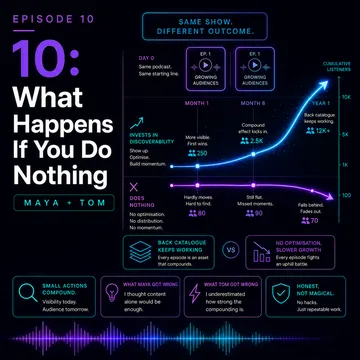
This episode, the season finale of "How to Get Discovered," explores the "invisible cost" of neglecting podcast discoverability. Through a thought experiment comparing two identical podcasts, Show A invests in discoverability (transcripts, show notes, data analysis) while Show B does nothing. After 12 months, Show A's back catalog generates new listeners through search, while Show B's audience remains stable, missing out on potential growth.
podcast discoverability· opportunity cost· back catalog· audience growth· search engines
00:00 Welcome back to How to Get Discovered. I'm Maya And I'm Tom This is the last episode of Season 1. HTGD has been a 10-episode argument about whether podcast discoverability matters, what it actually costs and what podcasters should do about it. Today's episode is the closing argument – It's called What Happens If You Do Nothing? And I want to flag up front that this is the episode where, by prior agreement both of us have to say something we got wrong over the last nine episodes. That was your idea It was my idea! I'm holding myself to it. I'm holding myself to it too Let's get into it
00:37 I want to start with a thought experiment. She always starts with the thought experiment! I always start with a thought experiment. Imagine two podcasts, same topic, same quality, same host capability. Both have been running for three years both have about 100 episodes in the back catalog both of us small but loyal audience let's say a few thousand regulars who listen every week Two roughly identical shows. Two roughly identical shows. Today, both shows make a decision. Show A decides to invest in discoverability — they get their transcripts done properly, they put them on their own domain… They start writing show notes that aren't useless...they look at the data when they have data… They make the basic moves And Show B?
01:25 Show B decides, explicitly or implicitly not to. Maybe they're busy. Maybe they don't believe it matters. Maybe they think the show speaks for itself The audio keeps going out Nothing else changes So both shows keep making episodes? Both shows keep making episodes Same number same quality The only difference is what happens to those episodes after they go out And the question is, 12 months from now? Where are they?" Twelve months from now. That's the question and I want to spend the first part of this episode answering it honestly — not optimistically—honestly. Month 1 Both shows look identical Show A has done some setup work Transcripts going up Pages being built Structure being put in place Show B is doing what its always done
02:19 From a listener's perspective, nothing has changed for either show. And from a measurement perspective? From a measurement perspective... also basically nothing! The new transcript pages exist but nothing is happening to them yet. Search engines haven't crawled them properly… the data is too thin to see anything This is the bit I personally experienced This is the bit you personally experienced Frustrating Frustrating Month 3. The first signal For show A, some episodes are starting to show up in search results for very specific queries—single digits, small
02:59 The shape of the data is...there are query terms appearing in the analytics that the host has never deliberately optimized for. The episodes have been found by people asking specific questions. And show B? Show B is unchanged, same listener base, same week-on-week numbers — their newest episodes are doing roughly what their newest episodes always do Right. Month six, now there's a visible gap show A is getting let's say a meaningful trickle of new listeners through search not a flood a trickle but the trickle is from the back catalog episodes from year one are getting listens they weren't getting before some of those new listeners subscribe some don't The total audience is and this is the thing a little bit bigger than it was
03:50 Not because of anything they did to the new episodes, because of work they did on the old ones. And show B? Show B's audience is whatever the natural drift is. Word-Of-Mouth is still happening — Tom is right about Word Of Mouth it's a real thing — so the audience is probably growing slightly but the back catalog is doing nothing Right... Month 12 Now The Gap Is Real Show A's back catalog is, by this point, doing a meaningful share of total listening. The newest episodes are still front-loaded—most of their listens still come in the first two weeks—but the back catalog is contributing a steady tail. New listeners are finding the show through specific moments from old episodes getting hooked subscribing
04:38 The advertising, for any sponsor who's still in the audio is reaching ears that weren't there at launch. Quantify the gap I'm not going to give a number because the number depends on the show but the shape Show A, at the end of year one of investment has a back catalog that is doing work Show B has a back catalog that is doing nothing This is the thing I want to push on because I think it's important ShowBee's audience didn't get smaller. The work didn't get worse, the host didn't fail at anything They just...didn't gain something they could have gained Which is a different kind of cost It's an opportunity cost It's not a loss it's a thing that didn't happen Yes And I think one of the reasons most podcasters don't do this stuff Is that opportunity costs are invisible You can't see what you didn't get You only see what you did
05:35 And so for show B, at the end of month 12 everything looks fine. The audience is roughly stable, the downloads are roughly stable, the work is going out... There was no obvious sign of a problem. Right Whereas show A, at the end of month 12 also looks fine Slightly better but fine The host might not even notice the difference unless they're looking at the right numbers So you've got two shows that from the inside both look like they're doing okay And one of them has invisibly accumulated an asset, and the other one hasn't. That is the cost of doing nothing! That's exactly it! And it's a quiet cost which is what makes it dangerous