
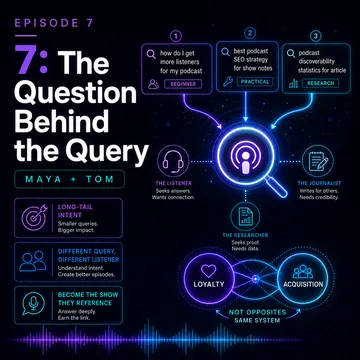
Episode 7 · Tuesday, 21 April 2026

The Question Behind the Query

Uncover the hidden intent behind listener search queries and learn how to cultivate a loyal audience by becoming a citable authority in your podcast niche.

By How To Get Discovered | 14m listen | 6 chapters
The Question Behind the Query cover
How To Get Discovered · No. 7

About this episode

The podcast "How to Get Discovered" introduces its latest episode, "The Question Behind the Query," which delves into the philosophical aspects of podcast discoverability. This episode explores long-tail search intent, how podcasts become reference material for journalists and researchers, and the relationship between listener loyalty and acquisition. Understanding listener intent is crucial for attracting and retaining an audience.

Hosts analyze three distinct search queries related to freelancing to illustrate different listener intents, such as "How do I negotiate my freelance rate without sounding desperate?" or "Best podcast for freelancers UK." This analysis categorizes listeners into "one-clip," "subscribe-or-not," and "authority" types, each requiring a tailored approach for discoverability. The episode emphasizes a podcast's role as a citable authority within its niche, influencing journalists and researchers who use similar search tools.

The discussion challenges the common perception that loyalty and acquisition are opposing goals, asserting that loyalty naturally follows effective acquisition. The focus shifts from optimizing for initial download spikes to attracting "stay listeners" who are more likely to become loyal, rather than "bounce listeners" seeking only quick tips. This refined strategy prioritizes long-term listener retention over short-term metrics.


CHAPTER 01 / 6 Discussion

How to Get Discovered: The Question Behind The Query

The podcast "How to Get Discovered" introduces its latest episode, "The Question Behind The Query," which delves into the philosophical aspects of podcast discoverability. The episode will explore long-tail search intent, how podcasts become reference material for journalists and researchers, and the relationship between listener loyalty and acquisition.

how to get discovered· podcast discoverability· long tail search· loyalty· acquisition

00:00 Welcome back to How to Get Discovered. I'm Maya And I'm Tom. HTGD is the show where we argue about how podcasts get found. Last week was the Easy Wins episode, and Tom got to be unleashed for 30 minutes which did wonders for him. I feel restored Today's episode is the one that, when we planned this series I thought was going to be the most technical one. It turns out it's actually the most philosophical one—it's called The Question Behind The Query and it's about three things that I think turn out to be the same thing...

00:36 Tease em. Long tail search intent, becoming the show that journalists and researchers actually reference and whether loyalty an acquisition are really opposites or whether we've been arguing past each other this whole season That last one is the one I want to get too We will get to it Let's start with queries I wanna read out some search queries Real ones Real Shape, anonymized. The kind of thing people actually type when they're looking for a podcast or looking for information that a podcast might contain. Tell me what each of them tells you about the person who typed it? Go! First one

CHAPTER 02 / 6 Discussion

Analyzing Listener Search Queries and Intent

The hosts analyze three distinct search queries related to freelancing to illustrate different listener intents. Queries like "How do I negotiate my freelance rate without sounding desperate?" indicate an urgent need for specific advice, while "Best podcast for freelancers UK" suggests browsing for a new show. "Should I be sole trader or limited company? Side project under 30k" reveals a listener seeking authoritative guidance for a specific decision.

search queries· listener intent· podcast discoverability· freelance rates· sole trader

01:15 How do I negotiate my freelance rate without sounding desperate? That person is about to have a conversation with a client. Probably this week, they're nervous They want very specific advice They're not browsing...they're shopping Right Now second one Best podcast for freelancers UK That person is browsing. They're not in the middle of anything urgent, they've decided they want a podcast about freelancing in their general region and they wanna know which one to subscribe to. They're gonna scroll a list and pick one. Good! Now third one...

01:52 Should I be sole trader or limited company? Side project under 30k. That person has a spreadsheet open, they've put in their numbers They want the answer to their specific case They are about to make a decision Right! Three queries all in roughly the same topic area three completely different people three completely different intents three completely different reasons for landing on a podcast And three completely different things you'd have to be, to be the answer to each. That's the whole episode right there! So this is the bit that I think gets missed in most SEO conversations. SEO advice for podcasters usually treats search as a thing you optimize FOR—you pick your keyword, put it in your title, put it in your description and wait for traffic…as if the listener is some sort of generic search-using person

CHAPTER 03 / 6 Discussion

Three Types of Podcast Listeners: Moment, Relationship, Authority

The discussion categorizes podcast listeners into three types based on their search intent: the "one-clip listener" seeking a specific tip, the "subscribe-or-not listener" looking for a long-term relationship with a show, and the "authority listener" needing trusted expertise for a specific problem. A podcast must present itself in different ways to satisfy each type, moving beyond a simple episode feed.

podcast listeners· listener types· one-clip listener· subscribe-or-not listener· authority listener

02:47 Right. But listeners aren't generic, they're the person who typed that exact query at that exact moment with that exact need and the query they typed is a window into what they actually want which means it's also a window into what you need to be to be the answer for them Give me the worked example Sure take the first query how do I negotiate my freelance rate without sounding desperate? that person doesn't want a podcast. They want, at most three minutes of a podcast—a specific exchange, a specific

03:25 They want a tip. They will not subscribe based on that visit, they might listen to 90 seconds of a clip get the answer and leave. That's a one-clip listener! That's a one-clip listener and that's fine because if the clip is good they remember the show's name maybe they share the clip maybe they come back when they have a more open ended question maybe they don't but the moment served its purpose Okay second query Best podcast for freelancers UK. That person isn't shopping for a moment, they're shopping for a relationship They want to know which show to add to their listening rotation They're gonna evaluate you over multiple episodes They want to like the host they want the show to feel like a fit that's a subscribe or not listener Subscribe-or-not listener and the thing that wins them is not the specific episode It's the show as a whole

04:19 Your voice, your taste. Your consistency. Your back catalog feeling rich. Third query Should I be sole trader or limited company? Side project under 30k That person needs an authority They need somebody whose opinion they trust on this specific question to walk them through their specific situation They will probably listen to one entire episode Maybe two if you have two on the topic They might not subscribe at all, but they will if you're good. Take what you said and act on it." That's an authority listener!

04:56 Authority listener. So now look at what we've got, three queries one listener wants a moment one listener wants a relationship one listener wants an authority and the same podcast might be the right answer to all three but only if it can present itself in three different ways as a clippable moment for the first one As a subscribable show for the second As a trustworthy expert for the third And most podcasts can't do that. Most podcasts can't do that, because most podcasts only present themselves in one way as a feed of episodes take it or leave it subscribe or don't there's no surface for the moment there's no surface for the authority claim There is just the feed and this is where I think the technical infrastructure conversation we've been having for six episodes actually starts to mean something

CHAPTER 04 / 6 Discussion

Citability and Authority for Podcast Success

The hosts emphasize the importance of a podcast becoming a citable authority within its niche. This means being referenced by journalists, researchers, and other podcasters, often appearing in articles, books, or other shows. Citability is directly linked to discoverability, as these influential individuals use the same search tools as general listeners to find content.

podcast citability· authority· journalists· researchers· discoverability· long-term audience

05:51 Because all those things we've been talking about—transcripts, structured pages, clips, your own domain—they're not optimizations. They're the surfaces that let your show present itself differently to different listeners That's a different framing That's a different framing The infrastructure isn't there to be found It's there so the show can be in the right shape for whoever finds it Now, I want to focus on the third one—the authority listener. Because that's the bit most podcasters are leaving the most money on the table on. Influence. Reach. Long-term audience quality? Maybe actual money, sometimes? But mainly the thing where your show becomes THE show that other people reference when they're talking about your topic. Sightability. Sightability! Yeah… There is a kind of show – and they tend to be quietly successful in way that doesn't show up on chart rankings – that journalists reference. That researchers reference. That other podcasters reference. Where if

06:54 Where if somebody is writing an article about freelance taxation, your name is in the article. If somebody's making a podcast about the same topic they mention you. If somebody is writing a book? You're in the footnotes! And those podcasts have something specific and common… Tell me They've been around for awhile. They've covered their topic deeply. They have episodes that you can point to as canonical on specific questions...and this This is the thing. They are findable when somebody goes looking for that question, yes! Because the journalist or the researcher or other podcaster… they're also doing a search—they're typing in a question into something and the shows they cite are the shows that came up. They didn't have some independent route to the show—they found it the same way everyone else does. That's the part I think most podcasters don't realize

07:47 Citability isn't a separate thing from discoverability. The journalist who's writing about freelance tax structuring is using the same search tools as the person who's about to incorporate, same queries often, same results. The journalist just has a different goal at the end of the visit. Which is? To quote you! To quote me or interview me or reference my show and the entire reason they were able to do that was because the show was findable when they were looking If the show was invisible, the journalist would have cited somebody else. My prior, which I've defended at some length over the last six episodes is that the real game is making a great show that loyal listeners love. And I still think that but what you're saying is even the version of that game where you become citable? Where you become the canonical voice on your topic where you become the show journalists reference Even that requires you to be findable because the journalist has to find you to cite you Yes

CHAPTER 05 / 6 Discussion

Loyalty and Acquisition: Not Opposites

The podcast challenges the common perception that loyalty and acquisition are opposing goals. Instead, it argues that loyalty is the natural progression of acquired listeners over time. Every loyal listener was once a stranger who entered through some "door," whether it was word-of-mouth, search, or a shared clip. The focus should be on acquiring listeners and then retaining them.

loyalty· acquisition· podcast listeners· word of mouth· search· listener journey

08:54 Which means findability isn't optional for the version of success I actually care about either. The depth version, the authority version not just the chase listeners' version Yes Hmm...I'm not gonna push on that because i think you got there yourself I got there myself and I'm not entirely happy about it Okay so now I want to do the thing I've been wanting to do all season which is I think loyalty and acquisition are not opposites. And I think you and I have been arguing about them as if they're opposites, and we're both about half right. And the thing we're actually talking about underneath is the same thing

09:37 make the case. Here it is, loyalty isn't the alternative to acquisition. Loyalty is what happens to acquired listeners over time. Every loyal listener was once a stranger. Every loyal listener entered through some door. The door might have been word of mouth. The door might have been search. The door might've been a clip somebody shared in a group chat. The door might've been a chart placement. The door doesn't matter What matters is what happened after they walked in. Right So the entire frame of should I focus on loyalty or on acquisition, that frame is wrong because the loyal listeners you have were all acquired The only question is whether you're set up to acquire more of them and whether when they walk-in what they find is good enough to keep them

CHAPTER 06 / 6 Discussion

Optimizing Acquisition for Loyal Listeners

The discussion refines the acquisition strategy, asserting that the most effective approach produces the most loyal listeners, not just the highest download spikes. The SEO industry often optimizes for initial visits or impressions rather than long-term retention. By understanding listener intent through search queries, podcasters can attract "stay listeners" who are more likely to become loyal, rather than "bounce listeners" seeking only a quick tip.

acquisition strategy· listener retention· SEO industry· search queries· loyal listeners

10:29 I want to push back on one part of that, because i think the way you phrased it makes it sound like all doors are equal. And I don't think all doors are equal The listener who walks in via a friend's recommendation is different from the listener who walks in via search Different prior, different relationship to you on arrival Different probability of becoming loyal That's fair. The doors aren't equal, the listener who walks in via a friend is in some ways pre-loyal they have a trust transfer happening from the friend Yes But that's true at the margins not at the whole

11:06 Because a listener who walks in via search finds a specific answer, has it land for them and listens to the rest of the episode. They're not pre-loyal but they can become loyal and every loyal listener you have started somewhere on the spectrum of doesn't know you exist so at some point that listener was a search listener or a chart listener or a friend recommendation listener they all had a first visit I take your point, but I want to add to it. Please! The reason I've been pushing back on the acquisition framing all season—and I think I can articulate it better now than I could in episode 1— is that the strongest version of acquisition is one that produces the most loyal listeners. Not the most listeners. Not the biggest spike in downloads. The version that produces listeners who three months later are still there

12:01 Which means the acquisition strategy can't be evaluated by acquisition numbers. It has to be evaluated by retention, yes! And I think the SEO industry—not you, the industry—tends to optimize for the wrong metric. It optimizes for the visit, the impression, the first listen not what happens after That's a real critique. And I think it's right! The visit is a means, not an end. The visit is a means, not an end... So when you talk about being findable — and I've come around on more of this than I expected to over six episodes — what I think matters is being findable in a way that brings in the listeners who are likely to stay, not the listeners who are likely to bounce. Which goes back to queries because the shape of the query is the shape of the listener

12:51 listener. And some queries bring in stay listeners, and some queries bring in bounce listeners. And you can – at least to some extent – design which queries you show up for and which you don't." Right… A show that wins on Best Podcast for Freelancers UK? Those listeners are coming in looking to subscribe. They're high-retention listeners by intent! A show that wins on Freelance Rate Negotiation Script? Those listeners are coming in for a tip They're low retention by intent, but they might share the moment. Different goals, different metrics – both legitimate And the mistake is collapsing them The mistake is collapsing them Treating every visit the same Treating every listener the same Optimizing for total visits when what you care about are the right visits This is the most useful conversation we've had this season It might be… it might be one I come back to